Latest AI News
Wipro Expands ServiceNow Partnership to Scale Agentic AI Workflows Across Enterprises
Wipro Intelligence suite will be integrated with ServiceNow’s AI platform to automate workflows across functions such as IT, HR, procurement and cybersecurity.
View

Google Partners with Polaris School of Technology to Launch AI and Cloud-Focused Degree Programme
Google collaborates with Bengaluru's Polaris School of Technology to integrate certified pathways, AI tools, and multi-million-rupee credits into a new degree.
View

TCS Partners Mistral to Build Custom Enterprise AI Models at Scale
TCS has partnered French AI startup Mistral to help enterprises build custom AI models using proprietary data.
View

Why India Inc Struggles to Retain Gen Z in the AI Economy
India’s employers are facing a new workforce reality as Gen Z workers, armed with AI-era skills, are moving faster than traditional career ladders can keep up with.
View

Is Claude Mythos Overwhelming Security Teams?
Organisations can find more vulnerabilities than ever before, but the sheer volume forces them to fix their fundamentals first.
View

Vertu wants CEOs to run companies from an AI foldable starting at $6,880
Luxury smartphone brand Vertu on Thursday unveiled a foldable phone powered by an AI agent that connects with enterprise software and coordinates workflows. The company is targeting executives who manage business operations and communications on the move. Called the Alphafold, the foldable smartphone starts at $6,880 for the calfskin version. Higher-end models feature bespoke finishes including alligator leather, 18K gold, and natural diamond accents, along with customized detailing. This continues Vertu’s long-standing strategy of positioning its phones as luxury status symbols aimed at affluent buyers. The company told TechCrunch that its highest-end standard model is currently priced at $46,800, with further customization options available. The launch marks Vertu’s latest attempt to reinvent itself for the AI era after struggling to remain relevant in the modern smartphone market. The Hong Kong-headquartered company, onceknown for luxury handsetsand concierge services popular among wealthy buyers before the rise of the iPhone, haschanged ownership multiple timesover the years as mainstream smartphone makers came to dominate the industry. Nonetheless, Vertu is betting the Alphafold can help reinvent the brand for the AI era by combining luxury hardware with enterprise-focused AI capabilities. Vertu’s Alphafold comes with Hermes Agent, built on top of the open-source Hermes project by Nous Research. The agent can connect to enterprise systems like ERP and CRM, and coordinate tasks such as approvals, scheduling, sales tracking, travel planning, and operational reporting through natural-language prompts. However, the company said that its Phone-to-ERP and VPS deployments would be customized for each customer depending on their existing enterprise systems, with pricing varying accordingly. The Alphafold, Vertu said, can route requests across multiple AI models including OpenAI’s GPT, Anthropic’s Claude, Google’s Gemini, and selected open-source models, while also integrating with more than 80 apps and dozens of native phone functions for cross-platform workflows. Existing AI features on smartphones from major manufacturers remain focused largely on consumer tools such as image editing and voice assistance, Vertu CEO Molly Ma said. This leaves room for more advanced AI-agent workflows tied to enterprise systems. She also pointed to earlier AI-agent smartphone experiments in China thatgained popularitybefore facingchallenges over data privacyand cloud-based data collection. The Alphafold, Ma said, aims to address those concerns through a privacy-focused architecture featuring a proprietary A5 security chip. This silicon is designed to isolate authentication keys, biometric credentials, and sensitive enterprise information from the main operating system, the company said. It added that commercially sensitive data can be processed locally on the device, while prompts sent to external AI models are redacted or tokenized before leaving the phone. While Vertu has emphasized the device’s privacy and security architecture, including on-device processing and data redaction features, the company said the system has not yet undergone third-party security audits or independent certification. However, Vertu told TechCrunch that independent audits and certification remain on its security roadmap “as an explicit next-stage commitment,” adding that it would “communicate the progress and the results publicly” once the product matures further. The Alphafold is powered by Qualcomm’s Snapdragon 8 Gen 4 processor and features an 8.05-inch foldable display alongside a 6.53-inch outer screen, a 6,500mAh battery, and satellite communication capabilities. The device also includes a triple rear camera setup with 50-megapixel primary and ultrawide cameras, as well as a 5-megapixel telephoto lens. Vertu said the phone’s hinge uses metal, titanium, and carbon-fiber components and is rated for up to 650,000 folds. The Alphafold is not Vertu’s first attempt to combine AI with foldable devices. The company last yearintroduced Agent Q, a clamshell-style foldable smartphone focused on AI-driven automation and productivity features. However, Ma told TechCrunch that Alphafold represents a significant step forward from Agent Q, arguing that AI-agent technology has matured rapidly over the past year, with improvements in memory, automation and app integration. Foldable smartphones remain a niche segment globally despite years of investment by major manufacturers including Samsung and Huawei. As many as 20 million foldable smartphones were shipped globally in 2025, accounting for less than 2% of total smartphone shipments, according to IDC data shared with TechCrunch. The research firm said foldables sold at an average price of about $1,300 last year — roughly three times the price of non-foldable smartphones. Kiranjeet Kaur, associate research director for mobile phones research at IDC, said foldables could eventually benefit from AI-agent workflows because their larger displays are better suited for multitasking and productivity-oriented experiences. She, however, added that enterprise AI adoption on smartphones still lags behind computers, and that most enterprise smartphone decisions continue to be driven by ecosystem integration and device management support rather than AI capabilities. The first 115-unit batch of Vertu’s Alphafold begins shipping this week across major markets including the U.S.
View

OpenAI’s New Tax AI Tool Processed 7,000 Returns With ‘Up to 97% Accuracy’
Co-developed with Thrive Holdings, the Codex-powered tool uses a three-step loop to continuously improve tax-preparation workflows.
View

OpenAI Commits $250 Million to Prepare Economies for AI-Driven Job Disruption
The funding will support research, labour-transition programmes, and economic policy experiments focused on managing the long-term effects of advanced AI systems on jobs, wages, and wealth distribution.
View

Cognizant, Travelport Partner With Anthropic To Build AI-Powered Travel Infrastructure
The collaboration aims to bridge the gap between AI-powered travel planning tools and legacy booking systems that still rely heavily on manual workflows and human agents.
View
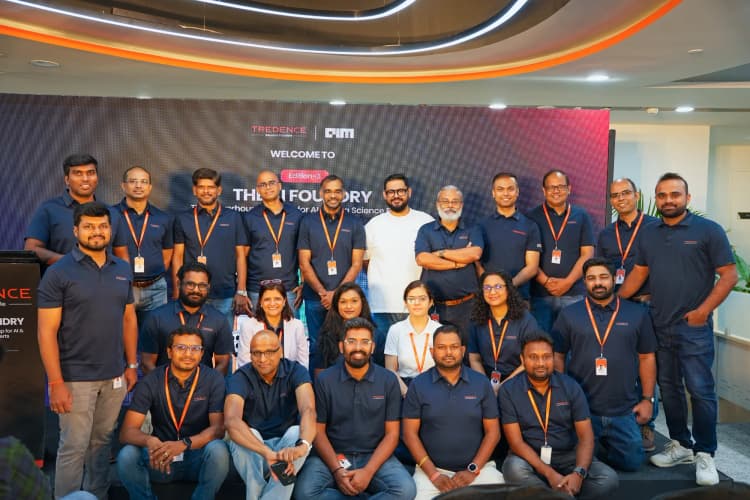
What Happened When Tredence Brought 100 AI Builders in One Room
The Hyderabad edition of Tredence AI Foundry saw AI professionals working in pods to build practical enterprise AI solutions.
View

Why Enterprise AI Projects Stall Between Pilot and Production
When the demo ends, and production begins, enterprise AI often stalls, caught between impressive pilot results and the harsh operational reality that no controlled environment has prepared for.
View

Snowflake Signs $6 Bn AWS Deal to Push Enterprise Agentic AI
Snowflake said the partnership will help enterprises run AI applications directly on governed data without moving sensitive information across systems.
View