Latest AI News

Visa invests in Replit to power agentic payments for developers
Visa has announced an undisclosed investment in AI coding platform Replit. The two companies are also exploring how to integrate Visa’s payment products into Replit, so that developers — and the AI agents they build — can accept payments directly from customers without leaving the platform. Visa added that more than 1,000 of its employees have been using Replit for prototyping and development. As part of the partnership, the companies are exploring how developers on Replit can use Visa’s suite for AI-powered payments, called Visa Intelligent Commerce, as well as Visa’s Trusted Agent Protocol — a system that allows AI agents to securely identify themselves by sharing information like their intent and relevant customer details, so that payments made by agents can be verified and trusted. All of these projects are in an exploratory stage, and the companies haven’t formally announced any joint products. The investment reflects a broader race to establish the infrastructure for so-called agentic payments — a world in which AI agents buy and sell things on users’ behalf. Besides Replit and Visa, other tech companies are also moving quickly in this space. Retail investing platform Robinhood now wants people touse agents to trade, while Google wants users to deployagents for shopping. “Over the last few months, our enterprise traction has been growing, and Visa coming on board underscores our mission of making coding available to anyone in a secure and robust manner,” Amjad Masad, CEO and founder of Replit, said in a statement. Replit is also launching self-serve enterprise access, allowing companies to sign contracts worth up to $200,000 without talking to a salesperson. The tier offers enterprise-grade compliance and controls, including SSO — single sign-on, a system that lets employees access multiple tools with one set of credentials — audit logs, and advanced permissions. “Our continued customer and partner additions in the enterprise, coupled with our new self-serve program, bring us closer to a world where any team can go from idea to production-ready software quickly and securely,” Masad added. As demand for so-called vibe-coding platforms has shot up, valuations of startups like Replit, Cursor, and Lovable have risen rapidly, along with investor interest. In September of last year, Replit hit the$3 billionvaluation mark. Six months later, in March, the company raised $400 million in a Series D led by Georgian Partners at a$9 billionvaluation — tripling its valuation in under six months. In May at TechCrunch’sStrictlyVC event in San Francisco, Masad said that Replit’s churn is very low, and customers are sticking around. “Churn is very, very low, and net retention is incredibly high — 300% in some cases. What we actually hear from customers is that when engineers get nervous and try to rebuild an app into their own stack, they often make it worse. Once enterprises get comfortable with the full Replit stack — especially when we set up a single-tenant environment for them — they keep the apps on Replit,” he said.
View

YouTube adds new podcast features, including an AI recommendation tool and ‘Auto speed’
YouTubeannouncedon Thursday it’s introducing new podcast features for Premium users, including an AI-powered recommendation tool, an “Auto speed” setting, and a new on-the-go listening mode. The update signals YouTube’s ongoing efforts to compete with other platforms for podcast audiences, especially as streaming giantNetflixis investing heavily in video podcasts. Additionally, by focusing on personalized discovery and hands-free listening features, the company also appears to be targeting users who consume podcasts on audio-first apps like Spotify and Apple Podcasts. The Google-owned platform’s “Ask Music” feature already lets Premium users generate personalized radio stations and playlists, and now users will be able to get podcast recommendations based on genres, their current mood, or shows they already enjoy. Users will also get access to a new “Auto speed” feature designed to make listening more efficient by intelligently adjusting playback speed during slower speech or information-dense segments, creating a more streamlined experience without sacrificing comprehension. While you can already adjust your playback speed, it can be inconsistent if the hosts are speaking at different speeds or changing their tone. With this new feature, listeners will be able to listen to content at a speed that addresses these changes throughout the conversation. The new on-the-go mode gives Premium users access to listener-friendly controls designed for activities like running, commuting, or multitasking. Users will get access to quick controls like skipping forward or backward, or jumping to the next episode. YouTube says the feature is designed to make it easier to get the most out of background playback. Auto speed and on-the-go mode are now available for Premium users on Android and are coming to iOS in the coming months. YouTube says Premium users watched over 800 million hours of podcasts in April 2026, and that YouTube Podcasts has over 1 billion monthly active users. With these new features, the company is looking to both retain and grow these numbers.
View

At TechCrunch Disrupt 2026: Databricks’ co-founder on what kills enterprise AI deals
Enterprise organizations are not rejecting AI. They are rejecting operational instability. That is the shift many founders still misunderstand — and it is becoming one of the defining realities separating enterprise AI companies that scale from the ones that stall after early momentum. For the last several years, AI startups benefited from a market driven by experimentation. A strong demo, an impressive model, and a powerful vision were often enough to generate enterprise interest, pilot programs, and investor enthusiasm. But enterprise AI is entering a different phase now, one where enterprises are no longer evaluating whether AI is exciting. They are evaluating whether it is safe to deploy broadly. AtTechCrunch Disrupt 2026,taking place October 13–15 at Moscone West in San Francisco,Arsalan Tavakoli-Shiraji, co-founder and SVP of field engineering at Databricks, will unpack that shift during his AI Stage session, “The Enterprise Isn’t Broken. Your Assumptions About It Are.” Disrupt will bring together 10,000+ founders, investors, and operators to explore the technologies and operational pressures changing how companies are built and scaled. The three-day event will feature 250+ sessions across six stages, led by tech leaders directing the industry today. Explore the sessions appearing on the Disrupt AI Stage.Ticket savings of up to $410 end on May 29 at 11:59 p.m. PT.Register here. The enterprise AI market is full of successful pilots that never became real deployments. Not because the technology failed. But because the organization could not absorb the operational consequences of adopting it. Now the reality founders need to face is that startup AI deals rarely die because the model underperformed. They die because the enterprise lost confidence in what the deployment would require. That is the gap Tavakoli-Shiraji’s session is designed to explore. Most enterprises are not simply evaluating whether an AI product works. They are evaluating: An AI product can perform exceptionally well in a controlled environment and still fail commercially if its deployment creates instability within the business. That distinction is important to founders because many AI startups are still optimizing for the wrong outcome. They are building for initial excitement rather than long-term operational adoption. And enterprises are becoming far more disciplined about recognizing the difference. Register for Disrupt to hear how enterprise AI leaders evaluate what actually survives beyond the pilot phase.Lock in your ticket savings of up to $410when you register by May 29 at 11:59 p.m. PT. The AI startups gaining traction inside large organizations increasingly share one thing in common: They reduce uncertainty. They integrate more cleanly into existing systems. They create less workflow friction. They are easier to govern, easier to explain internally, and easier for organizations to trust over time. That sounds less exciting than breakthrough demos or model benchmarks. But it is quickly becoming the difference between AI startups that generate attention and those that generate durable revenue. The market is maturing. Enterprise buyers are asking different questions now: Those concerns are no longer secondary. In many organizations, they have become core to the buying decision itself. For AI founders selling into the enterprise, this session breaks down what actually drives adoption after the pilot phase ends.Check out the session detailsandget your $410 ticket savingsto learn what to prioritize to gain traction with enterprise AI deals. Tavakoli-Shiraji brings an unusually relevant perspective to this conversation because his background spans both enterprise strategy and deeply technical systems architecture. Before joiningDatabricks, he was an associate principal at McKinsey & Company, advising enterprises, technology vendors, and public-sector organizations on cloud computing, next-generation IT, and enterprise transformation strategy. He also earned a PhD in computer science from UC Berkeley, focused on networking and distributed systems. That lens is valuable to startups because enterprise AI success increasingly depends on more than strong engineering alone. Founders now need to understand how technical systems interact with organizational behavior, infrastructure realities, procurement processes, governance concerns, and operational risk. The startups that succeed in enterprise AI over the next several years may not necessarily be the ones with the most advanced models. They may be the ones that best understand how enterprises actually absorb change. That is the kind of operational pressure that Tavakoli-Shiraji and other speakers on theAI Stage at Disruptwill explore. Presented by Google Cloud, the stage examines how AI agents and generative AI are reshaping SaaS, enterprise adoption, software economics, security, and operational infrastructure — including Tavakoli-Shiraji’s session on why enterprise AI success increasingly depends on operational trust rather than simply technical performance. Across the stage, founders will learn how and why the focus is shifting away from AI novelty and toward the real-world challenges of deploying, governing, and scaling AI systems inside real organizations. Explore the Disrupt agendaand learn how founders, investors, and enterprise operators are managing the next phase of AI adoption.Register by May 29 at 11:59 p.m. PT to save up to $410 on your passes.
View

RSI is the new AGI — and it’s just as hard to pin down
The word “recursion” is the latest buzzword in AI circles. Two separate startups have taken on the name, and many more have started referencing Recursive self-improvement (RSI) in their roadmaps. Like AGI before it, RSI has become a three-letter byword for a cataclysmic AI takeoff – even if there’s still a little disagreement about exactly what it means. In basic terms, RSI refers to an AI system that can continuously upgrade itself. Once AI systems can manage the upgrade cycle better than humans, the process can become a closed loop, limited only by the compute power they can access, and humans no longer necessary or even helpful. Scary or not, that’s a vision that a lot of AI labs are eager to chase. Earlier this month, well-known AI researcher, Richard Socher, launched the aptly named Recursive Superintelligence launched with RSI as an explicit goal. “Our main focus is to build truly recursive, self-improving superintelligence at scale,” Sochertold TechCrunch at launch, “which means that the entire process of ideation, implementation, and validation of research ideas would be automatic.” A number of other prominent researchers are already chasing that same goal, hoping for a breakthrough that will make recursive self-improvement possible. One of the most prominent is Alex Karpathy, a legendary figure from Tesla and OpenAI, who is using agent swarms to train LLMs on simple tasks for a project he callsAuto-Research. Karpathy has been unusually open about the project,tweeting about milestones regularlyand making the building blocks available through a public GitHub repo. So far, the work has mostly been confined to making minor improvements on a GPT-2 scale model – as Karpathy noted in March, “It’s not novel, ground-breaking ‘research’ (yet)” – but it’s been enough to convince lots of other researchers to follow the RSI dream. And with Karpathy now workingon pre-training at Anthropic, he will have plenty of opportunity to apply the idea at a larger scale. Adaption – founded by Cohere and Google alum Sara Hooker – recentlylaunched a similar tool called AutoScientistin an effort to automate frontier training. Like Karpathy’s auto-researchers, the system trains agents to make incremental improvements – but for Adaption, the goal is to make it easier to train a full-scale frontier model. If those same researchers start to push the frontier forward, the system could quickly spiral into something very much like RSI. Disarray founder Doris Xin drew more specific RSI interest when her self-trained machine learning agenttook home 28 medals in a recent Kaggle competition, beating out many human-trained agents. As she sees it, the major challenge is reliability. “I would argue, given infinite compute and infinite time horizon, we are already there,” Xin told me. “I want to make an argument that this is not a creative endeavor, really. It’s just a lot of meat-and-potatoes engineering.” There’s also plenty of evidence that the AI industry isn’t very close to recursive systems in any meaningful way — and is still grappling with talking to a wary public about its progress. So Google CEO Sundar Pichai basically admitted ina recent podcast interview. “It’s a continuum, and we are all definitely making progress,” Pichai said. “But in the way people describe R.S.I., that would represent a next level of acceleration and would have a lot of implications, but we aren’t quite there yet.” But the continuum includes an awful lot of self-improving AI systems.In January,one of Anthropic’s lead programmers for Claude Code estimated that “close to 100%” of his team’s code was written by the tool – a frank admission that Claude Code was literally writing itself. Just because engineers are using an AI tool doesn’t mean the tool can replace them – but Anthropic seems to be getting close to replacing engineers too. In a recent surveytied to the Mythos preview, five out of 18 Anthropic engineers believed that, with harness improvements, this version of Mythos could soon substitute for an L4 engineer – a mid-level programmer who can take on involved projects without supervision. Still, there were some of the same weaknesses you might expect. “Some of Claude’s major reported weaknesses compared to an L4 include: self-managing week-long ambiguous tasks, understanding org priorities, taste, verification, instruction-following, and epistemics,” the report reads. In other words, its weaknesses are everything involved with self-direction, which is the cornerstone for RSI. But sure, for everything else, Claude is ready to step right in. Just like the AGI term before it, the AI industry also can’t tell us how far away it is from showcasing a meaningful recursive system. When Georgetown’s Center for Security and Emerging Technologyassembled a group of experts to study RSIlast year, the group found a major split in assessments – some expecting an imminent “superintelligence” style explosion while others expected slower progress and an eventual plateau. But all agreed that recursion made the future especially difficult to predict. Helen Toner, director of CSET and a former board member at OpenAI, told TechCrunch that simply using AI tools to do AI research isn’t enough to qualify as RSI. “They’re just using AI for as much as they can,” Toner tells TechCrunch. “And I think that is different from the classic definition of RSI, which is really that there are no humans needed.” Toner points toa recent post by METR’s Ayeja Cotra, which distinguishes different milestones on the path to the AI research takeover. One step, which Cotra calls “adequacy,” would come when the system can still perform research after all humans are removed – even if the resulting research isn’t as valuable or efficient. “Parity” comes when an AI-only system is as good at research as a human-only system. “Supremacy,” the final stage, comes when an AI-only system outperforms a collaborative system between humans and AI. Ultimately, Cotra concludes that AI is very close to the adequacy threshold of being able to produce some work on its own – similar to the incremental changes made by Karpathy’s Auto-Research system. “I wouldn’t be totally shocked if you told me this milestone had already passed, and I expect it to happen in the next couple years,” Cotra writes. She’s less clear on when parity will come, but once it does, she thinks it would “massively accelerate the pace of AI progress, leading to AI research supremacy within another year.” With so much of AI built on scaling laws, there’s a strong tendency to think RSI will follow the same curve. Toner thinks that many of those pursuing AI research and development via RSI “ think of it as a pretty smooth ladder, where you can just keep scaling up.” But even if AI researchers are able to make incremental improvements like Karpathy’s auto-researchers, there will be larger challenges in handing off the whole process of research. Toner puts it in terms of the history of computing, which sees human beings handing off more and more of the process while still directing things from the top. “We went from machine languages to assembly language and compiled languages; you’re getting further and further from the guts of the computer,” Toner says. “But the human is still, in some intuitive sense, running the show.” Moving beyond that paradigm will take significant challenges, both in engineering and alignment. But even with the massive investments happening, there’s no infinite compute available – and the basic tradeoff between human labor and machine intelligence will be hard to overcome. As for a total recursive AI system of apocalyptic visions? The only thing researchers essentially agree on is that, like AGI, it’s not here yet.
View
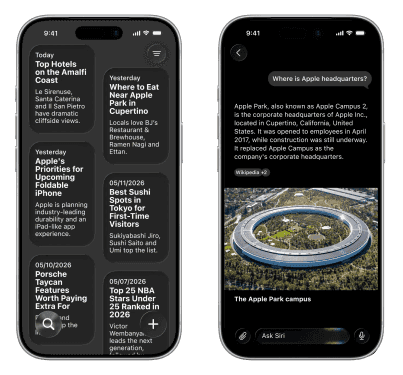
Sneak peek at new Siri app reveals Apple’s plans to take on ChatGPT and more
Just ahead of Apple’s Worldwide Developers Conference (WWDC) in June,Bloomberghas published leaked renders of what Apple’s planned AI upgrade could look like on iPhone — including a brand-new Siri app meant to rival ChatGPT and other AI chatbots — as well as how Siri’s new capabilities will be woven throughout the operating system. The images were produced by Bloomberg based on what it saw and learned from sources. While you’ll still be able to press a button in iOS 27 to trigger Siri, the animation and response will now emerge from the iPhone’sDynamic Island— that’s the black pill-shaped area at the top of the screen that today houses Live Activities, the real-time updates and interactive displays from apps that appear directly on the phone’s Home Screen. This mode will work best for quick voice queries or searches, much like how people use Siri currently. A new mode, however, will put Siri-powered search within easy reach, capitalizing on people’s muscle memory for swiping down on their screen to access Spotlight Search — a built-in way to find information from both your phone and the web in one place. The swipe-down gesture will still open search, but now those searches will draw on the AI-powered Siri, which includes a rebuilt AI model thatuses Google’s Gemini AI technology under the hoodfor added intelligence. From here, iPhone users can search, launch apps, start messages, ask about the weather, add calendar appointments, search their notes, and trigger app shortcuts, Bloomberg reports, with results displayed in formatted text in a card-style interface that also emerges from the Dynamic Island. Apple’s approach to AI is strikingly similar to its earliermulti-billion dollarpartnership with Google that made Google the default search engine on iPhone. Just as building a search engine from scratch was never in Apple’s playbook, AI presents a similar calculus — it’s too expensive and complex to go it alone, at least right now. So Apple is working with outside partners for AI technology that users want today, while simultaneously building out its own models,including local AI, that runs on local devices rather than the cloud — an approach that allows Apple to lean into it privacy brand without needing to catch up. Bloomberg also notes there will be a new standalone Siri app — as previously reported — designed to compete directly with chatbots like ChatGPT, Claude, Gemini, and others. The app will surface your past chat history and allow you to upload documents and photos, in addition to text. Scale, as ever, is Apple’s advantage. While ChatGPT now has900 millionweekly active users, Apple’s install base (all devices, not just iPhone) is2.5 billion— meaning the company has an unmatched runway to introduce AI to people who haven’t yet adopted standalone AI tools.
View

Sesame, the conversational AI startup from Oculus founders, launches its iOS app
On Thursday, the AI startupSesame, co-founded byOculus’s foundersand others from theVR company that sold to Meta, released a public preview of the conversational AI agents it’s been developing for over a year. With itsnew iOS app, Sesame is rethinking the traditional AI chatbot experience popularized by apps like ChatGPT, creating one where conversation flows, even if the AI needs time to think. As the company explains in its launchannouncement, “There’s an inherent tension between replying quickly and taking the time to compose thoughtful responses. A slower response is usually more correct, but it can also feel unnatural if it takes too long.” To address this challenge, Sesame claims to have built fast search and retrieval systems, so the AI can have up-to-date information, as well as technology that allows it to run multiple parallel searches while speaking, weaving those results into its responses as it talks. That means the AI will talk more like a human, even pivoting mid-sentence if need be, as it taps into newer information — as a human might when remembering another key fact or point they want to add. The app offers four distinct AI agents called Maya, Miles, Simone, and Charlie, each of which have their own distinct voice, personality, point of view, and memory. Maya and Miles werepreviously availablein Sesame’s Research Preview of its technology, where they were soon accessed by over a million people within the first few weeks,said Sesame investor Sequoiaat the time. (The company had then just raised its $250 million Series B from Sequoia and others, and was opening up a beta.) During the beta, Sesame learned from user feedback and rolled out features including search cards with image results for visualizing concepts, notes for capturing takeaways, a texting mode for those times when speaking aloud is not an option, and support for deep dives where you can get more in-depth results. There’s also a new incognito mode for private conversations, which allows the agents access to prior context, but saves nothing to memory. The app, however, is only the first step towards Sesame’s bigger plans for AI involving intelligent eyewear, which the team expects to launch in 2027. Before that, the agents will also learn to do more than just think with you, Sesame hints, suggesting they’ll later be able to take action on your behalf — hence why they’re called “agents” in the first place, instead of just chatbots. That is potentially even more interesting, as working with agentic tools or apps today requires being able to prompt for what you need and have a specific idea of what you want to happen, and sometimes, even how it should happen. A conversational agent that you could talk to naturally could help you take the next steps, without you having to perfect the command you’re giving it. TheiOS appis out today in 39 countries, and the full experience is free for the time being. However, there still may be a short waitlist at sign-up. AnAndroid previewis coming in the future, the company says.
View

How long is Anthropic’s lease with SpaceX? Opinions vary.
Earlier this month, xAI signeda major compute deal with Anthropic, pledging billions of dollars a month for exclusive use of the company’s Colossus cluster. It was a coup for both companies, giving xAI some much-needed revenue and helping Anthropic catch up in the never-ending race for compute. Butthis morning on X, Elon Musk downplayed exactly how much SpaceX had committed to the deal. “SpaceX has not committed to leasing Colossus for years, although it’s possible that may be what happens,” he said, replying to a user. “This is a 180 day lease with 90 day notice mutual cancellation thereafter. The short term was our request, not Anthropic’s. We won’t leave them hanging and will provide a reasonable off-ramp, but if compute gets super tight I said we might need it back at some point.” Musk’s statement directly contradicts SpaceX’srecent S-1 filing, which confirms the standard 90-day cancellation but presents the deal as a three-year agreement. Page F-62 of the filing reads: On May 3, 2026, the Company entered into a cloud services agreement with Anthropic PBC, an AI research and development public benefit corporation, with respect to access to compute capacity. Pursuant to this agreement, the customer has agreed to pay a monthly fee through May 2029, with capacity ramping in May 2026 at a reduced fee. The agreement may be terminated by either party upon 90 days’ notice. The customer will retain ownership and intellectual property rights in its content, AI models, and related data. The key point here is that Anthropic “has agreed to pay a monthly fee through May 2029” — a pretty straightforward description of a three-year lease. The same language is repeated on F-96 and in slightly varied form (“the customer has agreed to pay us $1.25 billion per month through May 2029”) on pages 13 and 146, so it’s not as if there was a typo. xAI did not respond to a request for clarification. Maybe we can quibble about whether Anthropic agreeing to pay for a service means the same thing as SpaceX agreeing to provide that service, but that’s not usually what “lease” means. And why have a one-way lock-in if either party can terminate the deal with three months’ notice anyway? I don’t have the deal in front of me, so I don’t know what it says — and neitherSpaceXnorAnthropicis saying anything about the duration of the deal in their announcements. Still, there should be a pretty straightforward fact of the matter here, and it’s not the sort of thing you want to make false statements about during a company’s quiet period. As always, we should note that the SEC probably will not do anything — and even if they did, Elon probably wouldn’t care. But this sort of does seem likea material misrepresentation made while marketing a security, which is bad karma at the very least. Sean O’Kane contributed reporting to this article.
View

Anthropic releases Opus 4.8 with new ‘dynamic workflow’ tool
On Thursday, Anthropicreleased Opus 4.8, the newest version of its most advanced publicly available model. The model is available everywhere, with standard pricing at the same level as the previous Opus release. The new model comes just 41 days after Opus 4.7 was released, a much faster upgrade cycle than normal for Anthropic. (The most recent Sonnet and Haiku models are three and seven months old, respectively.) The fast turnaround may have something to do with the chilly reception to Opus 4.7, which some usersfounddisappointing. That interval has also seen significant new releases forOpenAI’s Codexand Google’sGemini Flash model, increasing the pressure on Anthropic to keep pace. Opus 4.8 comes with the expected best-in-class benchmark results, but there’s also particular attention to how the model manages bad or uncertain data. In the launch post, Anthropic’s early testers found that the new model is “more likely to flag uncertainties about its work and less likely to make unsupported claims.” Echoing this point, a testimonial from Bridgewater associates said the biggest difference in the upgrade was “Opus 4.8’s tendency to proactively flag issues with the inputs and outputs of an analysis, something other models routinely missed and left to the users to catch.” Together with the new model, Anthropic launched a feature calledDynamic Workflows, which will be available in research preview. The system is designed to help larger models like Opus manage complex tasks across hundreds of parallel subagents. “Claude Code alongside Opus 4.8 can now carry out codebase-scale migrations across hundreds of thousands of lines of code from kickoff to merge, with the existing test suite as its bar,” the post explains. Anthropic is still holding back its most advanced Mythos model aftera tentative preview last monthraised cybersecurity concerns. However, the company hinted in today’s Opus release that the Mythos preview period might soon end, once necessary safeguards are complete. “We’re making swift progress on developing these safeguards and expect to be able to bring Mythos-class models to all our customers in the coming weeks,” the company wrote.
View
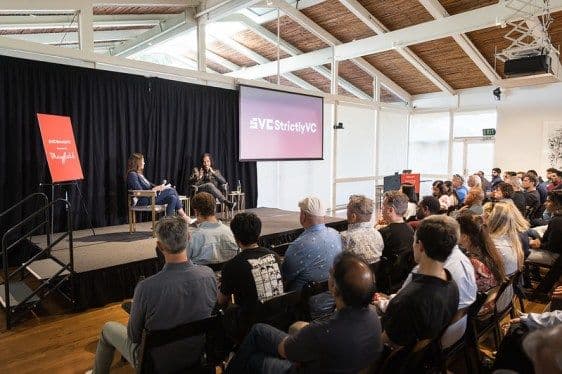
In just 3 weeks, StrictlyVC is coming to Los Angeles
Join us forStrictlyVC Los Angeles 2026, an intimate evening bringing together leading investors and entrepreneurs for high-signal conversations from the front lines of venture capital and frontier technology. Taking place Thursday, June 18, at The Aerospace Corporation Campus in El Segundo, this edition continues StrictlyVC’s focus on direct access to the ideas and leaders shaping where technology and capital are headed next.Secure your spot here. For executives, investors, and founders navigating an increasingly complex market, this is an opportunity to step inside conversations that rarely happen in public and hear directly from the people driving change across defense, AI, and advanced industry. We will begin the evening withEthan Thornton, founder ofMach Industries. In his session called “Built for a New Era of Defense Technology,” Thornton will discuss what it means to build a hardtech company at speed and why defense innovation is undergoing a structural shift as autonomy, manufacturing, and national security become increasingly interconnected. His perspective reflects a new generation of founders choosing to operate in industries once considered slow-moving, now rapidly reshaped by technological acceleration. Next the conversation turns to backing the next frontier of physical AI, featuringDelian AsparouhovofFounders FundalongsideSaif KhawajaofShinkei Systems. Together, they will explore how advances in AI, robotics, and automation are beginning to reshape not just software systems but the physical world itself and what it takes to move breakthrough technologies from concept to real-world deployment at scale. Additional speakers and conversations will be announced in the weeks ahead as the StrictlyVC Los Angeles agenda continues to take shape.Stay updated on new speaker announcements and event developments. As the evening unfolds, the room becomes the real value of the event. Conversations continue beyond the stage in a setting defined by access, focus, and proximity to the people actively shaping the next generation of companies. It is an environment where introductions turn into insight, and insight often turns into opportunity.Secure your spot here.
View

Devin Maker Cognition Raises $1 Bn at $26 Bn Valuation as Adoption Grows
The company said its annualised revenue run rate has reached $492 million.
View
Has the hunt for AI compute uncovered the next Cerebras?
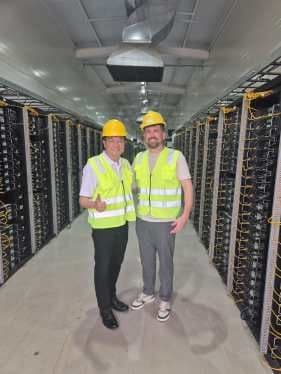
The raging demand for computers to run AI models has only accelerated, but there are two major obstacles that anyone in the business needs to overcome: getting the right chips, and getting them into data centers where they can start generating revenue. General Compute, a new inference neocloud — a company that rents out AI processing power, specializing in the phase when models are running and responding to users rather than being trained — has answers to those questions that illuminate where the AI ecosystem is headed. Those answers helped it raise a $15 million seed round at a $60 million post-money valuation, led by FUSE VC with participation from Carya Venture Partners and Village Global Ventures. First, what is the right chip? The demand for GPUs has gone through the roof, but it’s becoming conventional wisdom that they aren’t the best-suited chips for running AI models once they have been trained. The phase of AI where a model is actively generating responses has different computational requirements than training, and a new class of chips is being designed specifically for it. Nvidia’s $20 billion Groq transaction in December and Cerebras’ $57 billion IPO last week point the way. With capacity strained at both those companies, the co-founders of General Compute, CEO Finn Puklowski and CTO Jason Goodison, found another option. They’re turning to specialized chips built by SambaNova, an Intel-backed chipmaker focused on inference that has fallen a bit out of the Silicon Valley conversation. That may change when SambaNova releases its new chips this year. The architecture is more flexible and uses more memory to store context during inference calculations, and SambaNova claims that it outperforms not just GPUs but also other specialized chips built by the likes of Groq or Cerebras. Puklowski says the new chips will generate 600 to 700 tokens per second, versus about 250 tokens per second for GPUs. General Compute has $300 million of the company’s SN50 chips on order and says it will be the first neocloud deploying them. These chips also help solve the second big problem—where to put them—for General Compute: They are air-cooled, not water-cooled, and consume less power, so they can be installed in existing data center facilities without new infrastructure investments. Puklowski is pursuing colocation deals — arrangements where General Compute installs its hardware in someone else’s facility — not just with data center providers, but also with crypto miners looking to repurpose their infrastructure as the cost of producing a bitcoin has often exceeded its price. General Compute launched its cloud offering last week, claiming it is already the fastest at running MiniMax 2.7, a powerful open-source LLM. Joe Hasselmann is a venture investor who got in on the ground floor of the inference boom when he invested in Groq in 2021. This year, he launched a new fund, Evercrest Capital Partners, focused on the AI space, and made General Compute his first investment. Hassleman sees in SambaNova’s partnership with General Compute parallels to Coreweave’s relationship with Nvidia — and to the pairing of Groq’s chip-making with its former cloud offering. “They do need a healthy mix of customers that are going to put their chips in environments that are going to have high growth to them,” Hassleman said. “As much as General Compute is making a bet on SambaNova, SambaNova is making a bet on General Compute.” The question is what kind of computer architecture will capture the most value in the AI future. Inference clouds are implicit bets on a world of multiple models and agents, one where no single provider dominates and speed and cost of inference become the key competitive variables. Consider the$113 million Series Braised for OpenRouter this week, reflecting the company’s ability to offer customers access to multiple models in order to optimize their token spend. Speed matters in that calculation, for price, and for capability. Puklowski wants to turn hour-long workloads for coding agents into five- or ten-minute tasks, and make audio agents for customer service, which require faster inference to converse effectively, more economical.“If you use ChatGPT and it gives you 50 tokens per second, that’s still a heck of a lot faster than we can read,” Puklowski told TechCrunch, “Now that things have moved to agent-to-agent, where agents are out there reading on our behalf or pinging databases, they need to go faster.”
View

Confluent Launches Dedicated GCC Strategy in India as AI Adoption Accelerates
the GCC ecosystem is undergoing a structural shift, with centres functioning as captive support units
View