Latest AI News
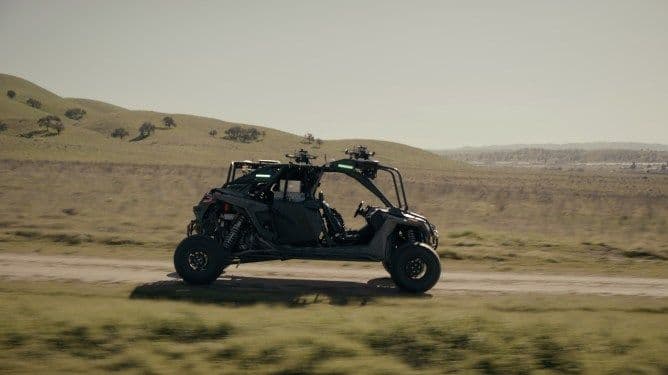
Colby Adcock’s Scout AI raises $100M to train its models for war. We visited its bootcamp
At a U.S. military base in central California, four-seater all-terrain vehicles roam hillside trails. This is a training exercise, but not for the people in the vehicles: It’s an effort to train AI models to enter conflict zones. The autonomous military ATVs are operated by Scout AI, a startup founded in 2024 by Colby Adcock and Collin Otis, that calls itself a “frontier lab for defense.” The company said on Wednesday that it has raised $100 million in a Series A round led by Align Ventures and Draper Associates, following its $15 million seed round in January 2025. Scout invited TechCrunch for an exclusive tour of its training operations at a military base it asked us not to name. The company is building an AI model it calls “Fury” to operate and command military assets, first for logistical support, but soon for autonomous weapons. CTO Collin Otis compares this work, which builds on existing LLMs, to training soldiers. “[Soldiers] start when they’re 18 years old, and sometimes they even start after college, so you want to start with that base level of intelligence,” Otis told TechCrunch. “It’s useful to start with someone who’s already made an investment and then say, ‘Hey, what do I have to do to teach this thing to be an incredible military AGI, versus just being a broadly intelligent AGI?’” Scout has secured military technology development contracts totaling $11 million from organizations like DARPA, the Army Applications Laboratory, and other Department of Defense customers. It is one of 20 autonomy companies whose technology is being used by the U.S. Army’s 1st Cavalry Division during its regular training cycle at Fort Hood in Texas, with the expectation that the unit will bring along products that prove themselves when it next deploys in 2027. For Scout’s internal testing, the rubber meets the dirt in the base’s hilly terrain, where the company’s operations team, led by former soldiers, is putting the vehicles through their paces on simulated missions. Autonomous cars are starting to be seen in more cities around the world, but they operate in more structured environments with rules. Operating autonomously on unmarked trails or off-road is another challenge entirely. Otis, who previously worked at autonomous trucking company Kodiak, said he was motivated to start Scout when he realized the system he helped build there wasn’t intelligent enough to operate in an unpredictable war zone. Scout is turning to a newer autonomy technology: Vision Language Action models, or VLAs, that are based on LLMs and used to control robots. First released by Google DeepMind in 2023, the technology seeded robotics startups likePhysical Intelligenceand Figure.AI, the humanoid robot company led by Adcock’s brother, Brett. Colby Adcock is on Figure’s board, and he says that experience convinced him of the opportunity to bring broader intelligence to the military’s growing fleet of autonomous vehicles. His brother introduced him to Otis, who was advising Figure, and they set about applying the latest in AI to military solutions. “If I handed you the controller of a drone right now and I strapped a headset on you, you could learn to fly that thing in minutes,” Otis said. “You’re actually just learning how to connect your prior knowledge to these couple little joysticks. It’s not a big leap. That’s the way to think about VLAs and why they’re such an unlock.” Indeed, I got a chance to drive one of Scout’s ATVs around the rutty trails, and the terrain was challenging: steep hills, loose sand on turns, disappearing tracks, confusing intersections. I’m not an experienced ATV driver, but made a fair go on my first attempt (if I say so myself). That’s the kind of general intelligence the company wants in its models, which it has been training using these ATVs for just six weeks — it started off using civilian ATVs. I also rode in the ATV under autonomous control, and could feel the difference — it accelerates faster than a human who might be thinking about a passenger’s comfort. The operations team pointed out how the vehicles hug the right on wider trails, but stay in the middle of narrow ones, like their training drivers. They also, when confused, suddenly slow down to think over their next move, which happened a few times as the ATV carried us on a 6.5 km loop before returning to base. Though the VLAs are new enough that they are yet to be deployed by any company in an operational setting, “the technology is good enough to be doing that experimentation in the field with soldiers to figure out how to most be effective to U.S. forces,” said Stuart Young, a former DARPA program manager who worked on ground vehicle autonomy. And like other autonomy companies, Scout’s full stack also includes deterministic systems and other flavors of AI to round out its agents’ capabilities. Young left DARPA this month to join Field after managing a program calledRACERthat asked companies to create high-speed, autonomous off-road vehicles, helpingseed this spacethe same way that the organization’s Grand Challenge boosted self-driving cars. Two competitors in this space, Field AI and Overland AI, were spun out of that program, and Scout also participated later. The first applications of ground autonomy, according to Scout executives and military technologists, will be automated resupply: Carrying water or ammunition to distant observation posts, or in a convoy where a crewed truck might be followed by six to ten autonomous vehicles, saving precious human labor for more important tasks. Brian Mathwich, an active duty infantry officer doing a stint as a military fellow at Scout, recalled a recent exercise in Alaska where he led a resupply convoy in total darkness and wished for autonomous vehicles to help him out. Scout sees itself primarily as a software company building an intelligence layer for military machines. It doesn’t intend to make the autonomous vehicles themselves, but instead build atop them. Adcock expects the startup’s first product to be widely adopted will be one called “Ox,” a command and control software bundled with hardened computer hardware like GPUs, communications and cameras. It’s intended to allow individual soldiers to orchestrate multiple drones and autonomous ground vehicles using prompts such as, “Go to this waypoint and watch for enemy forces.” However, making that software work requires training on real vehicles, which is why it has set up Foundry, its training range at the military base. There, drivers spend eight-hour shifts putting the ATVs through their paces, then work through a reinforcement learning system to log where they had to take over, which is used to improve the model. The base commander has even asked the company’s ATV to take a turn with security patrols. One hypothesis Scout is testing is that VLAs will enable this relatively limited data set, alongside training data in simulations, to deliver a fully capable driving agent. While the vehicle seems comfortable on trails, for example, it isn’t ready to operate fully off-road. Scout is also practicing with drones for reconnaissance and defense, giving them intelligence with vision language models. The startup is working on a system that would see groups of munition drones fly with a larger “quarterback” platform that provides more compute resources to command them. For example, the drones could search a geographic area for hidden enemy tanks and attack them, possibly without human intervention. Otis contends that the alternative approach in such a scenario might be indirect artillery fire, which is imprecise compared to drone strikes. While autonomous weapons are a flash point in the politics of defense tech, experts note the concept is old: Heat-seeking missiles and mines have been used in warfare for decades. The question for technologists is how the weapons are controlled, according to Jay Adams, a retired U.S. Army Captain who leads Scout’s operations team. Adams notes the company’s munitions drones can be programmed to only attack threats in a specific geographic area, or only following human confirmation. He also says autonomous weapons platforms are unlikely to fire because they are scared, the way an 18-year-old soldier might be. VLAs, too, hold promise for improving targeting. Scout says its models are pre-trained on a specific set of military data to prepare them for, say, running into an enemy tank while on a resupply mission. Lt. Col. Nick Rinaldi, who supervises Scout’s work for the Army Applications Laboratory, says that while automated targeting is hard and unlikely to be used outside of constrained environments in the near term, the potential of VLAs to reason about threats make them a promising technology to investigate. Adams says the promise of drones that can identify their own targets is key to warfare in the future. While Russia’s invasion of Ukraine has generated intense interest in drone warfare, he believes that humans operating individual UAVs doesn’t scale well enough for the U.S. to face a large number of low-cost unmanned systems should they threaten U.S. forces. Like many defense startups, Scout wears its mission on its sleeve, and its executives will freely criticize companies that are reluctant to hand their technology over to the government. Google, for example,reportedlypulled out of a Pentagon contest to develop control systems for autonomous drone swarms, a capability Scout is also working on. “The AI people don’t want to work with the military,” Otis told TechCrunch,referencing Anthropic’s spatwith the Pentagon over its terms of service. “None of them are open to running agents on one-way attack drones, or running agents on missile systems.” Nevertheless, Scout is using existing LLMs as the base to build its agents, though it declined to say which ones. Otis says it has agreements with “very well-known hyperscalers” to provide the pre-trained intelligence for Scout’s foundation model. He also declined to say if the company uses open-weight models, such as those offered by Chinese companies. Many companies reliant on AI inference build on top of open-weight models because they are cheaper compared to offerings from frontier labs like Anthropic or OpenAI. Scout expects to address this by building its own model from the ground up in the years ahead, and the founders say much of its capital will go into those training and compute costs. Indeed, Otis wonders if Scout will beat the existing leaders to AGI because its model will be constantly interacting with the real world. “There’s an argument in the AGI community along the lines that you can only get so intelligent by reading the internet, and most intelligence comes with interacting in the world,” Otis said. Does that mean Adcock is competing with his brother’s army of humanoid robots at Figure? No, Otis says, but “we can get to scale much faster because our customer has assets,” he said, referring to the Pentagon.
View

Musk Accuses OpenAI Executives of Turning Charity Into Business
Musk is expected to continue his testimony on April 29. A verdict could arrive as early as mid-May.
View

Why DeepSeek V4 Did Not Have an R1 Moment
Besides DeepSeek, new releases from Qwen, Moonshot AI, MiniMax, and others have captured production traffic.
View

AI is Dismantling Both Big Tech and Indian IT Jobs—But Differently
Meta and Microsoft eliminated 23,000 positions in a single day, but Indian IT is pulling back more quietly, more conditionally.
View

OpenAI Falls Short of Revenue and User Targets as It Races Toward IPO, WSJ Reports
OpenAI has fallen short of its goals for new users and revenue in recent months, sparking concern among some company leaders over whether it can support its extensive data-center spending, the Wall Street Journal reported on Monday, citing people familiar with the matter.
View

Lovable’s Vibe Coding Platform Is Now Available as an Android and iOS App
Lovable, the popular artificial intelligence (AI)-powered full-stack coding platform, launched its mobile app on Monday. Available on both the Play Store and the App Store, the app brings vibe coding capabilities to smartphones and lets users generate websites and apps on the go. While the mobile app does not come with the full functionality of the website, users can still prompt their ideas, preview the results, and iterate on them. The startup has also added cross-platform support, allowing users to switch between the app and the website without a hitch.
View

Tech Layoffs Surge: March Worst Month in Two Years as Companies Slashed 38,000 Jobs, Layoff Tracker Claims
Tech companies across the globe are working to integrate AI-powered tools into their daily workflows, citing higher efficiency and lower costs. This appears to be a great proposition for the tech firms, who can increase their margins, increase their profits, and keep their shareholders happy, even if they record the same revenue every quarter, year after year. However, this unprecedented AI adoption has led to massive layoffs across the industry. Another phenomenon fueling the dismissals is the mass pandemic-era hiring, when the blue-collar employees at tech firms ballooned exponentially.
View

TSMC Sells Over 1 Mn Arm Shares, Lets Go of All Stake
The filing shows a full exit from the Arm investment with a $174 million impact on retained earnings.
View

Lovable Launches Mobile App for iOS & Android, Brings Vibe-Coding to Smartphones
The new app allows users to build AI-powered applications using voice or text prompts while adhering to Apple’s evolving rules for code-generating platforms.
View

OpenAI Brings GPT-5.5 & Codex to AWS as Microsoft Exclusivity Ends
OpenAI models will be accessible via Amazon Bedrock, allowing customers to build applications using existing AWS services and governance systems.
View

Why Developers are Abandoning GitHub Again
“Github has been down for most of the day. I'm so tired of this. Never been so ready to move on.”
View

GitHub Changes Copilot Pricing To Usage-Based Model Starting June
GitHub said the change is intended to align pricing with actual usage.
View