Want to get featured here? Explore premium visibility opportunities.

Contact us

AI NewsI tried Amazon’s Bee wearable and am both intrigued and slightly creeped out

I tried Amazon’s Bee wearable and am both intrigued and slightly creeped out

11:01 PM IST · May 24, 2026
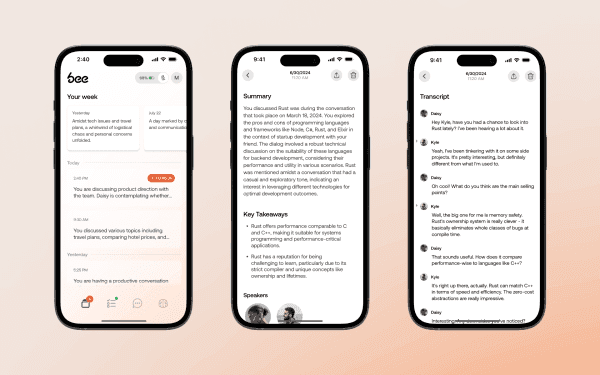
I tried Amazon’s Bee wearable and am both intrigued and slightly creeped out

I recently had the opportunity to test out a wearable fromBee, the AI wrist gadget that Amazonacquiredlast year and has sinceupdatedwith a number of new features. Like other AI wearables, Bee is designed as a kind personal assistant: it records, transcribes, and summarizes the user’s conversations throughout the day, providing an ongoing note-taking capability that’s useful if you’re forgetful or just want to be more organized about your life. If you sync it with your calendar, it can also send you alerts and reminders about things you’re supposed to do throughout the day. TechCrunch haswritten about Beebefore, and the way it works is pretty simple: the user powers it up, puts it on, syncs it with the Bee mobile app, and enters some basic personal information. Bee has a built-in recorder that can be turned on and off by clicking the wearable’s button. When Bee is recording, a green light flashes. When it’s not, that green light goes off. After a conversation has been recorded, the app will create an automated summary that is easy to read, as well as an entire transcription of the conversation. Your mileage may vary on how exciting (or not) this whole conceit is. The problem for me is that I am something of a privacy enthusiast. In a world where the average person is beset from all sides by constant digital surveillance, I appreciate any opportunity I can get to not be recorded. Therefore, the idea of walking around with an eavesdropping gizmo strapped to my wrist 24/7 was not particularly appealing. Yet, even I have to admit that — in the right context — Bee could have a lot of potential to help organize your life. Bee really comes through in the context of professional engagements. If your day is full of meetings and you have trouble keeping it all straight, Bee could be a moderately competent assistant. During a business-related phone call this week, I activated Bee after getting confirmation that I could record our meeting. Afterward, the app faithfully regurgitated a summary of the conversation, helpfully breaking down each segment of our talk so that I could review it later without having to re-listen to our entire conversation. This was undeniably helpful, although it should be noted that this isn’t something that’s markedly different than those offered by other transcription services,like OtterorGranolaand others, which also offer transcriptions and auto-generated summaries. That said, you could envision a situation in which a professional who has to navigate between various meetings throughout the day would be well-served by this device. You could just keep Bee running throughout the day and, later, review the conversation summaries for anything you’re not clear about. Bee does a relatively good job at summarizing conversations, but the actual transcripts offered by the wearable can be a bit of a mess. Previous critics have noted that you usually have to manually enter the names of other speakers, as Bee doesn’t always know who is talking. During my conversation, I noticed that it had also omitted certain sections of our chat — nothing huge, but it wasn’t a complete account of everything that had been said. I also took Bee to my semi-weekly movie night with my friends and left it running throughout the night. Given the fact that we watchedReservoir Dogs, I was mildly afraid that the wearable would mistake all of the vulgar carnage for real-life bloodshed and potentially trigger some sort of internal alarm. However, Bee knew — basically — what was happening. The wearable figured out that we were watching a movie and, in the summary of events afterward, the wearable labeled the conversation “Tarantino Film Scene Analysis.” While Bee shows early promise as a professional tool, I would not want this thing recording me in my personal life. Weirdly enough, Bee has largely been marketed as a product for personal use. To be comfortable with that, you have to be comfortable with Bee having access to a majority of both your offline and digital life. Indeed, to work well, Bee needs expansive mobile permissions — including access to your location, photos, phone contacts, calendar, and mobile notifications. You can also share your health data with it — should you, for whatever reason, want it to know about your sleep patterns or your resting heart rate. The large accumulation of data Bee collects is stored in the cloud, which — again, for the digital privacy enthusiast — presents its own concerns. In a message to tech YouTuber Becca Farsace, Bee apparentlyunveiled a demoof the device running entirely locally. Were the company able to produce such a device, I would be thoroughly impressed — and might even consider buying one. That said, Amazon hasn’t offered any update on those plans. As for Bee’sdigital privacy protections, the company says that it offers encryption to protect user data — both at rest and in-transit. In its privacy policy, the company states that it has “implemented technical and organizational security measures designed to protect the security of any personal information” that the company processes. Bee also claims that it undergoes “rigorous third-party security audits” and employs continuous security monitoring. That all sounds quite good, although it’s worth noting that Amazon — like many large tech companies — has been subject to the occasionaldata security issue or two(not exactly surprising for a company that governs as much of the global cloud environment as it does, but still). In short, Bee is a curious piece of hardware that, given some time and some tweaking, could have some promising professional applications further down the road. As a digital assistant for your personal life, however, it might prove to be a little too invasive for some users.

read more


Latest AI News

View All News →
Nobel-Winning AlphaFold Scientist John Jumper Leaves Google DeepMind for Anthropic

Nobel-Winning AlphaFold Scientist John Jumper Leaves Google DeepMind for Anthropic

For his work on AlphaFold, Jumper shared the 2024 Nobel Prize in Chemistry with Demis Hassabis and scientist David Baker.

4 hours ago

View

How Hexaware's GIFT City Move Gives Indian IT a New Financial Frontier

How Hexaware's GIFT City Move Gives Indian IT a New Financial Frontier

Hexaware plans to create nearly 1,000 high-skilled jobs over the next three years.

8 hours ago

View

Encryption, spyware, and now Mythos: History shows why cyber export control doesn’t work

Encryption, spyware, and now Mythos: History shows why cyber export control doesn’t work

Last Friday, citing unspecified national security concerns, the White Houseordered Anthropicto restrict the export of its powerful AI models Fable and Mythos to anyone outside of the United States, as well as foreign nationals inside the country. Shortly after, the AI giant hastily pulled the plug on both models, which have now been unavailable to anyone for a week. The episode is the first real test of whether the U.S. government can use export controls to contain frontier AI the way it has tried, with very uneven results, to contain encryption and spyware before it. And dramatic as it may sound, how this standoff gets resolved could shape not just Anthropic’s access to foreign markets but the rulebook that other AI labs will have to build around. Some context first.Ever since Anthropic launched Mythos in April, the company has marketed it assome kind of Doomsday cyber machinethat could wreak havoc on the internet if released too widely — which is why, before the ban,only around 150 vetted companies and government organizationshad access to it at all. The goal was helping defenders secure their software and services before the bad guys could reach Mythos-like capabilities. So what triggered the ban? Two subsequent events, reportedly. The first: Anthropic gave a South Korean telecom access to Mythos through its limited partner program, and U.S. officials grew alarmed after identifying the company as one they suspected had ties to China. (The company,widely reportedto be SK Telecom, hasdeniedany China connection.) Amazon CEO Andy Jassy also reportedlyalerted the administrationafter Amazon’s own researchers, he said, found a way around Fable 5’s safeguards. Anthropic disputes the “jailbreak” label, calling it a narrow, already-patched issue rather than a wholesale defeat of the model’s safety measures. The result was the same: the Commerce Department issued an export control directive, and Anthropic had to scramble to immediately limit access to its products — within roughly 90 minutes of being notified, by some accounts. None of this is new, though. Governments have tried to use export controls to limit the proliferation of what they see as dangerous cyber technology for decades, but their track record has been middling at best. The U.S. government was behind what is perhaps history’s most spectacular failure of this approach in the early to mid-1990s. At the time, computer scientists were developing encryption technologies to secure data as it traveled over the internet. One of those encryption products was called Pretty Good Privacy, or PGP, a popular software that could encrypt data and make it virtually impossible to unscramble even if intercepted as it traveled to its intended recipient over the internet. The U.S. government initially saw PGP as a dangerous weapon, fearing it would prevent its intelligence agencies from snooping on emails as they crossed their wires. To stop the distribution of PGP, the U.S. Customs Serviceopened a criminal investigationagainst PGP’s creator Phil Zimmermann for allegedly violating arms export controls. He fought back by publishing PGP’s source codeas a printed book, igniting what is known today as the “Crypto Wars.” Zimmermann later won a key battle when the investigation was closed, paving the way for crucial end-to-end encryption algorithms such as the one used by billions of Signal and WhatsApp users. Later during the early 2010s, researchers began discovering Western-made spyware used against dissidents in the Middle East. In response, several governments agreed to expandthe Wassenaar Arrangement, an international treaty that limits the export of dual-use software and technologies that are used in both civilian and military applications. The idea was to classify surveillance and hacking software as dual-use, thus forcing spyware makers to get export licenses to sell their products abroad. Contact UsDo you have more information about the Mythos ban? From a non-work device and network, you can contact Lorenzo Franceschi-Bicchierai securely on Signal at +1 917 257 1382, or via Telegram and Keybase @lorenzofb, oremail. But Wassenaar has always had two inherent weaknesses. There are several countries that don’t adhere to the agreement, including Israel, which houses some of the world’s most active spyware makers. The agreement also depends on countries applying it to companies within their borders at their own discretion. For a time, the Italian government allowed one of the country’s then-top spyware makers, Hacking Team, a license to export its tools around the world, despite the company’s track record of selling spyware tooppressivegovernmentsthatused itto hack journalists and human rights activists. Since then,othercountriesin Europe have been lax with spyware makers like Italy. Despite numerous scandals, Europe, home tomany spyware and hacking tools makers, hascontinually failed to curb the export of spywareto authoritarian regimes. Critics say that a recently renewed effort across the bloc of 27 member states to tackle its growing problem of spyware exports to authoritarian states “does not go far enough.” Several spyware makers, such as Intellexa, a sanctioned consortium of spyware companies,  have simply moved their operations to countries with lax export controls. Other spyware makers sought to move their operations to Saudi Arabia for similar reasons. There have been some wins. Germany-based spyware maker FinFishershut down in 2022after a multi-year investigation by German prosecutors into the company forallegedly selling spywareto Turkey without an export license. Investigators previously found the FinFisher spyware had beendeployed on the phonesof critics of Turkey’s government. As of the time of writing, the impasse between Anthropic and the Trump administration remains. There is a reasonable chance the administration will buckle and lift the restriction in the interest of keeping American AI companies competitive worldwide — a move that would amount to tacit acknowledgment that AI labs elsewhere, including in China, will likely reach similar capabilities regardless of what the U.S. restricts. Or, American AI companies could end up needing government approval before serving foreign customers at all, a compliance burden that would invariably dent their bottom line. Given the past experiences that world governments have had with trying to control the reach of software, government-mandated export controls are unlikely to be the right approach to stop malicious actors from abusing powerful dual-use cyber technologies.

12 hours ago

View

Billionaire Ambani wants AI in every call, app, and home

Billionaire Ambani wants AI in every call, app, and home

As India searches for a homegrown contender in the global artificial intelligence race, billionaire Mukesh Ambani is positioning Reliance Industries as a national champion, rolling out AI services for phone calls, mobile apps, and connected homes. At itsannual shareholder meetingon Friday, the Mumbai-based conglomerate announced Jio Call Agent, an AI assistant that can join phone calls to transcribe conversations, generate summaries, and perform tasks such as booking cabs, ordering food, and making reservations. The service, which can be activated by saying “Hey Jio,” is expected to launch later this year for Jio’s more than 500 million users. By embedding the service directly into its telecom network rather than offering it as a stand-alone app, Jio is betting AI assistance can become a native feature of phone calls. The approach could reduce consumers’ reliance on third-party call-assistant apps and give Reliance a powerful distribution advantage in an increasingly crowded AI market. Reliance also unveiled an AI-powered version of its MyJio app that can perform tasks on behalf of users, from activating eSIMs to selecting roaming plans, through natural-language requests. The company further introduced TeleFrame, a home display that uses AI agents to proactively surface information and recommendations, such as weather alerts, schedules, and household reminders. The product appears to echo a broader industry push toward ambient AI assistants for the home, an area being explored by companies such asAmazonandGoogle. The announcements mark the next phase of Reliance’s AI ambitions as India seeks to build domestic capabilities in a field largely dominated by U.S. and Chinese technology companies. The push follows thelaunch of Reliance Intelligencelast year, through which the conglomerate aims to develop AI infrastructure and services for consumers, businesses, and governments, including applications that support 22 Indian languages. “India should not be a mere consumer of AI created elsewhere. It must become a creator, adopter, and a global leader in AI,” Ambani, age 69, said. Reliance has been ramping up its AI ambitions through partnerships withGoogle,Meta, andNvidia. Earlier this year, the company announced plans toinvest $110 billion in AI infrastructureas it seeks to establish itself as a major player in India’s emerging AI ecosystem. At the shareholder meeting, Reliance also unveiled a suite of AI services for healthcare, education, agriculture, and small businesses. The products, branded JioHealthIQ, JioLearnIQ, JioKrishiIQ, and AI Vyapar, are designed to operate across multiple Indian languages and cater to local needs, the company said. The shareholder meeting also brought a major development for investorsawaiting Jio’s stock market debut. Ambani said Jio Platforms’ board had approved a draft prospectus for an initial public offering that would include a fresh issue of up to 270 million shares, according to a stock exchange filing. The announcements also raise questions about how Reliance will handle user data as it expands AI services across phone calls, mobile apps, and connected homes. While the company said the services would operate with user consent, it did not answer questions about whether data generated through the products could be used to train AI models or shared with technology partners. Reliance’s AI ambitions come as Indian companies remain heavily reliant on foreign AI models and cloud providers.Recent restrictions on accessto some of Anthropic’s latest models have underscored that dependency, showing how decisions made overseas can affectstartups and businessesbuilding AI products in India — the kind of supply-chain risk that’s pushing Indian conglomerates toward building their own stack rather than renting someone else’s. Last week, Reliance announced acollaboration with Meta to establish an AI data centerin the western state of Gujarat, building on Meta’s earlier investment in Jio Platforms and a joint venture launched last year to develop AI solutions for enterprise customers in India and overseas markets. Reliance is not alone in pursuing AI opportunities.Tata Consultancy Services,Infosys, and rivalAdani Grouphave also expanded their AI initiatives and partnerships with global players, including Anthropic, Google, and OpenAI, as India’s largest corporations race to secure a leading role in the country’s AI future. Nonetheless, for Reliance, the stakes are particularly high; it’s preparing Jio for a long-awaited stock market debut and needs new growth drivers, with the conglomerate’s shares down about 17% this year.

20 hours ago

View